
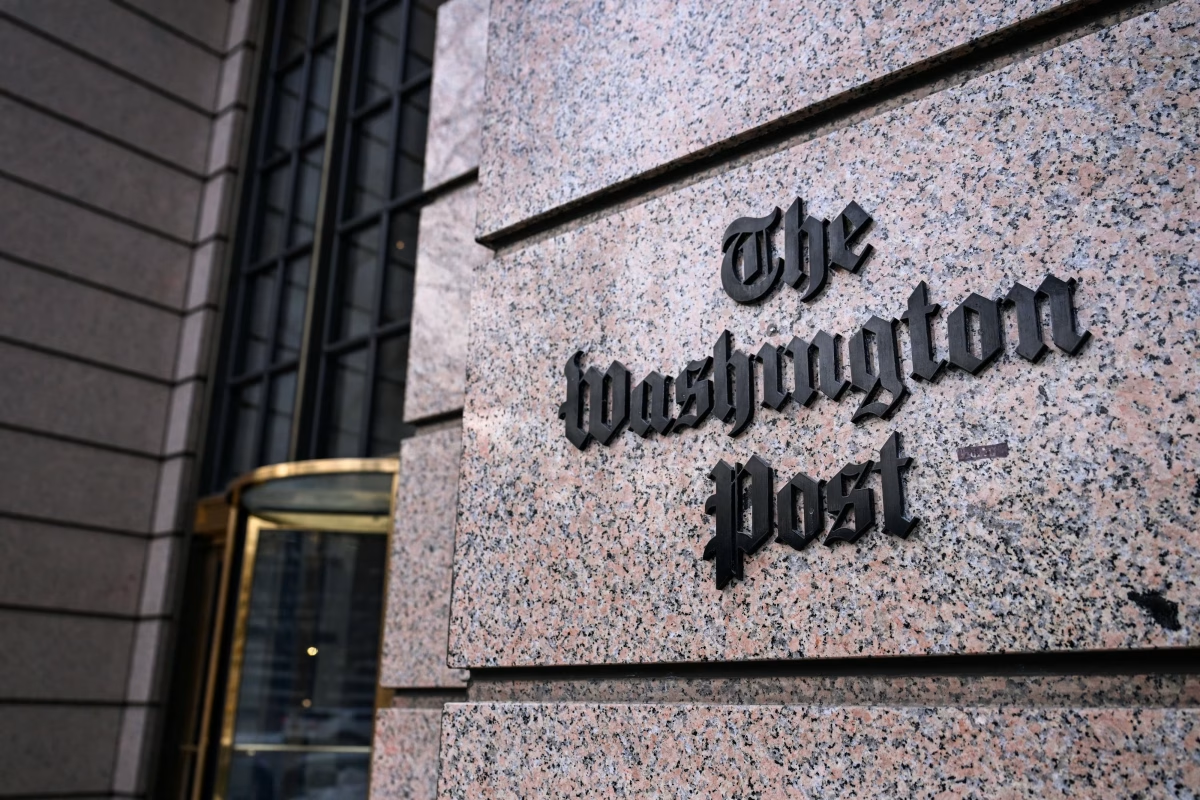
Last month, one of America’s most famous headline-makers became the headline itself. The Washington Post laid off more than 300 journalists amid financial pressure and declining readership.
February 4, 2026, marked one of the largest newsroom reductions in the paper’s history. While the layoffs are framed as a business decision, they underscore a broader financial crisis arising in traditional news organizations. The Post’s reduction of nearly one-third of its staff mirrors an industry-wide struggle to adapt to quickly changing audience habits in an era shaped by digital platforms, social media, and declining advertising revenue, raising questions about the long-term sustainability of comprehensive, original investigative journalism.
The consequences of these cuts are substantial. Nearly thirty percent of all staff was eliminated, significantly lowering foreign international coverage while dismantling entire departments. Newsrooms faced major losses across the Middle East, Ukraine, and Asia, and in particular, impacted some reporters who documented Israeli military action in the Gaza Strip. Miriam Berger, a Pulitzer Prize finalist, noted that the recent ceasefire in Gaza makes this an opportune moment to inform the public about casualties, political developments, and possible outcomes of the conflict. Such retrospective reporting can influence the public understanding by educating audiences on the human cost of conflict and clarifying why continued coverage and engagement remain crucial. Similar concerns apply to reporting on the war between Ukraine and Russia. Francesca Ebel was one of the few English-language newspaper journalists reporting from Russia, making repeated trips to document the war firsthand. Her reporting captured the reality of the brutal war—soldiers missing feet, legs, and hands, doused and filthed in mud. Ebel also included rare testimonies from Russian soldiers. Her work became a front-page story in The Washington Post just a couple months prior to the layoffs.
Beyond foreign reporting, the layoffs also eliminated coverage that connected the paper to its local community and everyday readers. Eliminating The Washington Post’s standalone sports department is also considered widely damaging as it dismantles a premier, award-winning team known for in-depth analysis and consistent support of women’s sports. In a region defined by athletics (home to eight major professional teams and numerous colleges), the sports desk documents labor disputes, equity issues, and the broader social influence of sports on the D.C. community. Its elimination hinders coverage and further distances the paper from the lived experiences of its readers.
The loss of specialized desks in foreign coverage and sports is simply illustrated by Ashley Parker, a recently laid-off journalist, who states, “We’re witnessing a murder,” warning that this crisis reflects the newspaper’s diminished ability to “hold power to account”. This upheaval marks a shift from experienced journalists offering personal and creative perspectives to a leaner, AI-driven model focused on national politics and policy, overall abandoning the traditional type of coverage.
The contrast is striking: since Jeff Bezos bought The Washington Post in 2013 for $250 million, his personal wealth has surged by over $224 billion while the paper continues to lose roughly $100 million a year. The cuts are a sign that Bezos, who became one of the world’s richest people by selling things on the internet, has not yet discovered how to properly build and maintain a profitable publication. As one critic noted, “The paper expanded during the first several years of his ownership, but the company has sputtered more recently.” This situation serves as a reminder that journalism is no longer immune to the pressures of profit, and that the future waves of layoffs could be potentially even more detrimental.